
Was there any specific film that made you want to center your film on the death of a sibling?

Oh my gosh, I don’t think so. I think this was more me pulling from my own experiences because… not so fun fact is that I’ve seen people lose loved ones, and it’s not fun, especially if that loved one is a sibling. So, because I was seeing these things almost firsthand, those experiences definitely lent themselves to how I was able to encounter the dynamic of a sibling losing a sibling.
It’s horrible because the way they lost their sibling was really violent. But this happens, right? The unexpected happens, and you lose someone without thinking that you’re gonna lose them. What kind of stories would help us come out of that, or help us move through these things. What story could I possibly contribute, you know? I feel like this film, Ramyun and Tangerines, contributes to that pain and hidden grief that most people don’t want to show.
I noticed there aren’t any parents present in the film. Was that intentional, or just kind of how it ended up?
My process when I write something — because I wrote this film — first I have a concept, and I have a character whose story I want to tell. Once I have a general logline or like a little summary, I add characters. What characters are needed to get this particular part of the story across? It just so happened that this character did not need parents in order to tell the story of losing a sibling. So while the character has parents, she’s the primary caregiver. Because there’s a huge age gap between her and her sibling. So, she’s dealing with this by herself, which I think is also the biggest thing about this film. Because sometimes a bad thing can happen to a family, but everyone processes it differently. So sometimes it can feel very lonely, even though she’s not alone. In this story, it probably felt lonely for her, and that’s kind of where I wanted to make it evident.
Did you host the basketball tournament, or did you just happen to film a basketball tournament?
Yeah, I actually had footage from the Emmanuel Black Tournament which is hosted by a family friend. So I think that year I was a videographer, and I was like, “this works perfectly.” We’ve held [the tournament] annually in August for four years now, and it’s been something that we do on Staten Island to kind of bring the community together, especially the youth.
Talk about how you made the music to match the atmosphere of the film?
I did it in FL Studio. The process was just me and I started off with a drum. Though, I don’t know that much, so please take this with a grain of salt. How I make music is I start off with a drum beat. Then I’ll probably add either a brass instrument then piano or vice versa. Then I’ll think to myself, okay, what else does this need? Maybe like a hi hat or a clap, which is the “Tss Tss Tss” sound… I couldn’t pay $1,200 for a song. So instead, I imagined if a young kid made a song, like imagine this girl is just living life, but her perspective is always on her younger brother, so even the music, the soundtrack of her life, probably sounds like a child made the song, right?
It probably sounds a little scattered and a little punky, but trying to become something, and that’s how the song kind of feels. And then there’s the version during the basketball tournament where the trumpets are blasting and it feels more emphatic. I did that to symbolize this next step, this next layer of music that becomes beautiful when you honor this person that you lost. You know, even if the song’s not complete, even if you didn’t get to see your brother grow up. There’s still a kind of growth in what he left behind, you know. So the soundtrack kind of lends itself to that, and it just happened to work out.
Was there a metaphor behind all the orange and blue colors throughout the film?
Ooh, yes, specifically the orange. The blue just kind of happened because you know color theory, and blue complements orange. But yes, definitely orange because I had a couple of symbols in the film for example the basketballs and tangerines. I really wanted to pull this theme through the film because her brother’s favorite things were ramyun (ramen), tangerines, and basketball. To me, making sure that the colors of those symbols stood out the most was a high priority for me. Especially considering that there weren’t a lot of characters to bounce off and help move the story along, or literally tell the viewer what’s important.
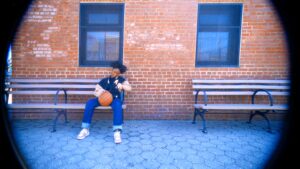
Was there what was the artistic choice behind using all these different lenses as you shot your film?
Oh my gosh! Thank you for asking. The average line of sight including peripheral vision is 180 to 200 degrees when you’re looking straight ahead. So in the film, I was like, “What if I just block that off? What if she, this character, and the perspective of how she lives life is super scattered? When something traumatic happens to you, sometimes you only see that thing. Sometimes it’s like life is happening around you, but you don’t see that extra stuff in the peripherals. Hence, in the film, I limited the viewer’s perspective. Sometimes she sees more, sometimes she sees less. It wasn’t like I intended to do that. It revealed itself in post-production. Using a one zoom lens I shot film at different lengths. You can zoom in and out, and that can distort the barrel, which then dictates how much the viewer sees, and I thought it really helped to tell the story of how she may be seeing things differently depending on the day, because that’s what it’s like when you’re trying to heal.
What was the most challenging aspect of this film?
I don’t know. That’s a good question. I’m not sure if I felt like anything was that challenging. Um, maybe filming myself, cause you know I’m like, dang, am I in focus or not? Do I have to refilm this? Just doing everything solo was the challenging part, but also doing it solo was the best thing. It helped me become super fluid. I know what I want, so I’m just gonna do that. So in that sense, it was great, but you know you can’t see yourself. So that was a little bit of a time sink. But yeah, I guess that was the biggest challenge.
Final question, really just a bonus question: What is your favorite ramen brand?
Oh, oh my gosh! I love Indomie so far. Indomie. It’s like this brand of noodle that I grew up knowing about because I’m Nigerian, right? But apparently, there’s a type of indomie that’s like I guess Korean. You get it at a Korean store, or maybe at a Target now, and it tastes so freaking good. There’s like a spicy barbecue one or something with a hint of sweet in it, and I’m like, yes, give me 10 of these now.
Like it’s insane. Give it a shot. It’s not the same as instant noodles, where it’s just powder. Like this has actual stuff in it that you put inside of the noodles, like seasonings and little like cracker things and like oil, sesame oil, and like another sauce. Yeah, it’s proper. Like I mean, not proper, but it’s better than the you know, Cup O’ Noodles.