
The film includes archival footage to bring Vieques’ history to life. What was the research and acquisition process like for locating, accessing, and securing the archival materials featured in the film?
One of our biggest challenges in this film was getting archival material here from Puerto Rico. Sadly, a lot of archives are underfunded, and are understaffed. Most of them only have one person working. We had to give a lot of hours voluntarily in the archives to see what they have because most of the stuff wasn’t digitized.
We worked directly with el Archivo Histórico de Vieques [the Vieques Historical Archive] for two months digitizing everything with a label that said Vieques. Also, in the section of Imágenes en Movimiento [moving images] from the General Archive of Puerto Rico, we found material that hasn’t been seen in the world. Living in a colony, the system functions in a way that they don’t want us to keep our memory alive. But even though there is almost no governmental support for the archives in Puerto Rico, there are some individuals doing a colossal job to safeguard our collective memory, like Marisel Flores and Osvaldo Rivera.
It was a challenge, but it was really rewarding knowing that while doing this documentary we were helping to preserve our history.
How did you approach constructing the film’s timeline? How did you identify and connect with the individuals whose stories are featured?
Juan Carlos, the director of this film, interviewed Carlos “Taso” Zenón four times in 2013. In those four interviews, Zenón gave us his everything. He wrote a book that was like our Bible while working through this film, because the book streamlines all his struggles in Vieques.
Also, there’s a book that Tere Villegas wrote, she’s the biographer of Carlos “Taso” Zenón. I think it was a mix of those two books and also the interviews with Zenón that gave us a clear view of the timeline, how we were going to tell his story, and podemos usar el material del archivo para probar [we could use the archival materials to prove], that yeah, everything he said, he lived it. It’s there. It’s history.
Much of the archival material came from Aleida Encarnación, Zenón’s widow. She opened her personal archive to us, and there we found gems. For us, it is a big responsibility to tell Zenón’s story and part of telling the story the way he would have wanted was having his family involved in every step of the process.
The film includes deeply personal accounts of the US military using intimidation, violence, harassment, and displacement against the locals. How did you approach documenting these experiences while being respectful?
In Puerto Rico, we witness abuse frequently in different forms. I don’t want to say we’re used to it, but the institutional violence is on a day-to-day basis. So it’s not something new. But seeing how the Viequenses (the native residents and people of Vieques) experience imperialist violence and hearing the stories from people that lived it, gives you another layer of what violence looks like in a colony. It’s hard, it’s difficult, but it’s our history. We have to hear it. We have to voice it.
It’s really painful, and we wanted to do it in a respectful way. I think that giving them the space to tell this story is part of the healing. Otherwise they would keep these stories and nobody would know. Part of reclaiming their dignity is letting the world know that this happens even in U.S. territories.
How did you build relationships with residents in Vieques throughout the filmmaking process? What did those relationships contribute to your understanding of the history and the film itself?
In Vieques, there’s no hospital, the groceries are super expensive, and transportation is really difficult. Living in Vieques for two years, we saw firsthand how Viequenses live. It’s really important that when you’re filming a documentary you give something back to the community. Vieques is a place with almost no entertainment for the young people. It doesn’t have a movie theater, it doesn’t have many parques [parks], it doesn’t have many places for the kids to go.
We made a podcast with the high school students for a year. They would choose the people that they would like to interview, and it was a really great experience having young people interested in communications. We were connecting with people and I think that really helped us to gain the trust of the community that we want to be here, and we will be coming back and still be doing everything that you need to help, especially the younger ones.
Why do you think it is important to highlight the environmental and public health impacts on the community?
Vieques is mostly a Black community, and it’s no una casualidad [not a coincidence] that they chose Vieques to have these military war games to experiment with all this bombardment. Nowhere else in Puerto Rico has the high cancer rates, tumors, diabetes, hypertension. All the enfermedades [sickness] that the Viequenses have is heavily correlated with the Navy presence there.
Like Zenón said, Vieques is an inconclusive battle. The Navy left, but they left those lands to the Fish and Wildlife Service, and haven’t done the work they should be doing. They should be cleaning, taking the bombs out, and giving the land back to the Viequenses. Part of the film is to highlight the environmental racism that Vieques is confronting, to hold the U.S. government accountable for what they did, and that they should clean those lands and sea so the Viequenses could gain again their quality of life.
What do you hope younger audiences take away from these stories of youth-led resistance?
I think when we talk about the youth, I’m really hopeful.
I’m gonna answer this in Spanish.
Yo creo que la juventud es bien importante. Históricamente en Puerto Rico, la juventud ha sido un catalizador para mover a las masas, y luchar por lo que es correcto. Yo veo mucha esperanza en la juventud, y yo espero que se lleven de la película que sí se puede, si identificamos nuestras problemáticas y nos organizamos, no hay enemigo grande.
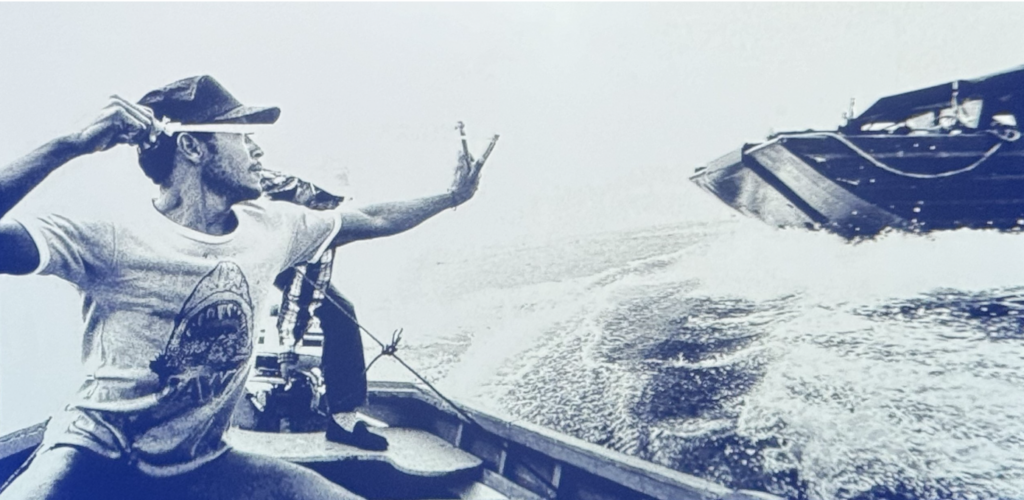
Los pescadores en Vieques y toda la comunidad viequense luchó contra el ejército más poderoso del mundo, los Estados Unidos. Los pararon en 38 ocasiones en el mar, y pararon los bombardeos de sus tierras en el 2003.
Así que yo creo que es una lección bien grande para la juventud, el ver estos ejemplos de lucha, y de que es posible organizarnos y poder ganar frente a enemigos, no importa cuán grandes sean.
Carlos “Taso” Zenón estaba bien claro del rol de la juventud y como es necesario pasarle la batuta a los más jóvenes. Por eso el libro que él escribe “Memorias de un pueblo pobre en lucha” va dirigido a la juventud. Nos deja un manual a los más jóvenes de cómo organizarnos y luchar.
[English Translation: I think the young people are very important. Historically in Puerto Rico, the youth has always been a catalyst to move the masses, and fight for what is right. I see a lot of hope in the youth, and I hope they take away from the film that it is possible if we identify our problems and organize ourselves, there is no big enemy.
The fishermen in Vieques and the entire Vieques community fought against the most powerful army in the world, the United States. They stopped them 38 times at sea, and stopped the bombing of their lands in 2003.
So I think it’s a very important lesson for the youth to see these examples of struggle and that it’s possible to organize and be able to win against enemies, no matter how big they are.
Carlos “Taso” Zenón was aware of the role that the young ones play and how it’s necessary to pass the baton. That’s why his book, Memorias de un pueblo pobre en lucha, is directed at the youth. He leaves us a manual on how to organize and fight the power.]
Looking back at the filmmaking process, is there a particular scene, interview, or creative decision that is especially meaningful to you, and why?
I’m gonna answer this in Spanish.
Mirando para atrás a este proceso de producción, lo más significativo para mí fue escoger que esta historia la contara Carlos “Taso” Zenón. Escuchar de su propia voz la historia de su lucha, la historia de su pueblo, la historia de su gente.
Yo creo que para mí lo más significativo de esta producción definitivamente fue darle voz a Zenón y a toda la gente que estuvo codo a codo con él luchando, que, de otro modo no hubieran tenido este chance para contar su historia.
Y escuchar de la voz de los pescadores, escuchar de la voz de los activistas que estuvieron allí en la lucha de Vieques, escuchar del propio Zenón lo que se vivió en Vieques desde 1940 hasta el 2003. Yo creo que eso es lo más poderoso de la película, escuchar de los que vivieron esa historia.
[English Translation: Looking back at this process, the most significant thing for me was choosing to have this story told by Carlos “Taso” Zenón. To hear from his own voice the story of his struggle, the story of his town, the story of his people.
I think that for me the most significant thing about this production was definitely giving a voice to Zenón and all the people who were side by side with him fighting, who would otherwise not have had this chance to tell their story.
And to hear the voice of the fishermen, the voice of the activists who were there in the struggle of Vieques, to hear from Zenón himself what he lived through from 1940 to 2003, I think that’s the most powerful thing in the film, to hear from those who lived that history.