
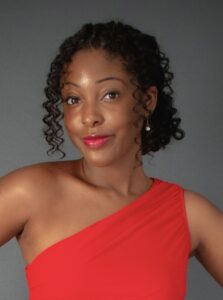
Audra Nicole is an up and coming young filmmaker and educator. The Spelman graduate first came to BPM’s attention when her animated short, The Hale Academy, was one of 10 films BPM selected for participation in the inaugural HBCU Week NOW Student Film Festival. We recently caught up with her as another of her films, Empathetic, has been selected for inclusion in this month’s Afrofuturist Femmes Film Festival, Nov. 6-7, at Fisk University in Nashville.
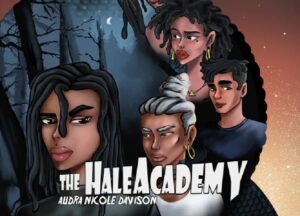 For your film, Hale Academy. Why did you decide on the comic book style of animation?
Thank you, that’s a great question. I was able to develop the Hale Academy through a filmmaking contest that was hosted by Facebook (Meta), and the Black House Foundation through that contest we had about two months to develop an original script into a full-fledged film. I don’t know how much you know about animation, but it takes a long time, and it costs a lot of money, too. So, in order to condense costs and to be realistic with the timeframe. Robert Davison, who was my co-creative director and I figured that using the comic book style would still give a satisfying and finished story.
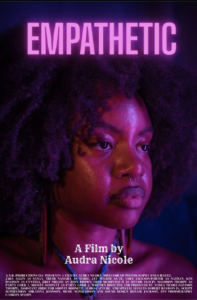 What was the impetus for your film Empathetic?
When I graduated from Spelman, I came up with the idea for Empathetic just as I was entering University of Georgia (UGA), to get my Master’s of Fine Arts in Narrative Media Writing, with an emphasis in screenwriting. So, I came into that program with the idea for Empathetic, based on my personal experiences dealing with people-pleasing, and obviously empathy. I’ve always been interested in fantasy and sci-fi and I wanted to tell a story that dug deep into what it means to be an empath every day, and how it can be a gift or a curse, and how it can drain you if you don’t use it wisely.
When and how were you first exposed to the concept of Afrofuturism?
I was exposed to it, I think, as a child and didn’t know it, you know? Like, things like Twitch’s, That’s so Raven, but at Spelman, I actually took a course that gave it the name Afrofuturism or Black speculative fiction, and just…getting to read books by Octavia Butler, ugh, love her! Yeah, and then getting to rethink, and at the same time as I was taking that course, Lovecraft Country, the TV show was coming out. I mean, come on! I already loved seeing Black people in sci-fi settings. Whether it’s a book or a film, but understanding the political and social commentary that can, play… that’s really, in my eyes, the forefront of Black and Afrofuturistic storytelling. That’s when I really developed my passion for it, and my love for it as well.
Since you’re doing the writing, the directing, and apparently the editing. How do you approach all of that for each film?
Writing is the easiest part. I’ve always been a writer, so that’s my favorite. Directing is different, because I also enjoy that, too. Directing for an animated short film is completely different from directing live action. Directing the Hale Academy was a lot easier because I really just had to coordinate with our animator.
But for Empathetic it had been 2 years since I had directed on set, not on set, but, like, in that role. So I was nervous, and I’m always nervous before I direct a short film. Funnily enough, previously I mentioned my people-pleasing tendencies serving as an inspiration for making Empathetic. I’m still struggling with those tendencies to this day, so I don’t like to be bossy to people. I can be, but I don’t like it because I just want everyone to get along. But I think I was able to do that and create a safe and welcoming space, while also keeping everyone on task. So, I think the main thing I go with for directing is trying to figure out a way to be productive, but also welcoming to everyone. Editing is sooo fun to me, I like the art of editing in general; putting clips together, syncing the audio, and doing transitions. It’s like a jigsaw puzzle for me, so it’s something I look forward to on every project that I do, so yeah, I guess I like them all equally.
For the first scene in Empathetic how did you decide to have that be the audience’s, first look at the film?
So that’s actually how the TV pilot script starts off as well, because I just think it’s such a banger of an opening. I’ve had the chance to do table reads with that script in my UGA program, and they were like, “oh, now I’m intrigued” or “what’s going on here?” From an artistic standpoint, I wanted to convey how being an empath feels to me. Because sometimes it feels like I don’t have a choice in understanding other people’s perspectives all the time, or excessively caring about other people. I’m not trying to say that that’s necessarily a bad thing because empathy can be very good.
However, everything should be used in moderation. So, as someone who’s an empath and a people pleaser, I wanted to convey that feeling of just pure exhaustion, and feeling emotionally pimped out. Just playing with the idea of not being able to properly regulate your emotions regardless of where you’re at and who’s around you. I think that’s Sanna’s journey throughout the short film. Because she’s giving these euphoric feelings to everyone else, which in turn depletes her. But yeah, to answer your question, I chose that scene to get people invested, and I really wanted to connect the idea of being an empath to your own peril with the idea of feeling pimped out emotionally.