
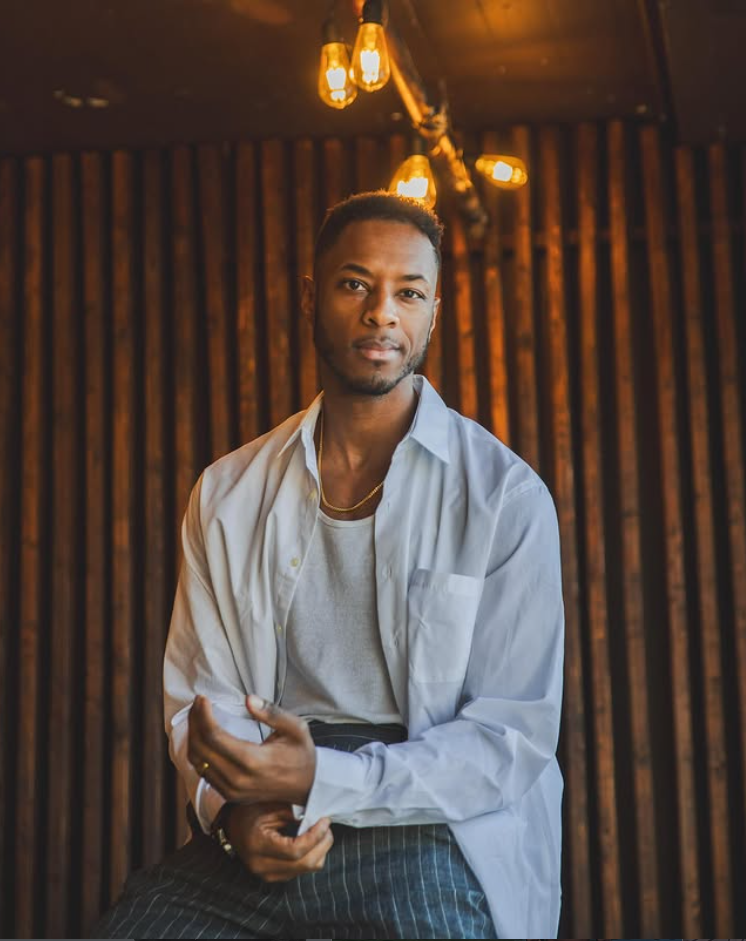
Your film unfolds to a poem that runs the length of the film. Which came first, the poem or the film?
I definitely would say the poem came first. I’ve always been a writer. Before I was carrying a football or trying to dribble a basketball, I was writing stories. I found that again during the pandemic. … I wondered why do men, specifically Black men feel this insatiable need to accomplish? And, what is it that’s stopping us from resting? Out of that came this thought of my dad and myself and this relationship that I was having at the time.
When I first started exploring the story, I had just turned 30. I was having a difficult time realizing that there were a lot of similarities between me and my father. That led me to wonder if I’m going to be someone who doesn’t feel like he can rest, who doesn’t feel like he’s good enough. It’s not to say that you don’t have respite moments, but there’s always this feeling of am I falling behind? Have I done enough? And especially during COVID when there was such an uncertainty to what society, what the future would be. And so I started to write about my dad and what I’d known him to be.
In the opening minute of your film, there’s a man giving a dialogue. What is his relation to you and the story?
That’s actually my grandfather, Ron Taylor. I spent time with him during the pandemic, which is when that footage was taken. He’s always operating in this place of allowing God to just, like, order his steps. So, I was just like, hey, I’m just playing with this camera, and of course, the second I bring a camera out, he kind of turns on this whole persona. He goes on and shares this rather long monologue. Then halfway through, his body language just shifts, and he’s like: “You know, I was making movies when I was a kid.” We don’t realize that there’s just so much to our older generation, because they’ve lived for so long.
He started to share about the Peasant Street Players, which was a Black repertory theater troupe that he was a part of founding in Providence, R.I.. As he goes on sharing, I think there was something of a realization for me that storytelling was always in my blood.
In some of the close-up shots on your father, the camera gets blurry and kind of shaky. Was that a specific artistic choice?
So, some of it was by happenstance. I was using a handheld Canon because it’s COVID, and I ain’t got no crew. It was just me. I’m learning how to focus and, Oh Crap! It was blurry in this moment. But I think, that’s interesting, so why not? …
As time went on, I got so much more interested in the idea of how, in life, we sometimes perceive things through a blurred lens. Especially as men who are constantly thinking we know what we’re seeing, thinking we’re crystal clear. My wife will be the first person to tell me, “you missed that, Doron.”
So I think I’ve gotten really interested in this idea of the closer you get into something actually, the more blurry it is. Fast forward two, three, four years later — I can confidently go, yeah, that’s just my style. At times, I think cinema plays the inverse, right? It’s like we want crystal clear when we’re super close up on it but, actually, it’s only when you’re further out that you get a cleaner picture.
Towards the middle, I believe it starts in the barbershop scene, you switch back and forth from a warmer tone of light to a colder tone of light. What did that mean?
This was another happy accident in trying to learn how to color correct. The way you light things impacts how much color you can do, especially if you don’t shoot in RAW. There’s something beautiful about creating and letting the happy accidents inform your cinematic language.
Again, these are all tools and skills that I would learn years later as a producer, then eventually as a director on another project. But at the time, I was like, how do I fix this? Well, there’s no fixing it and you’re stuck with that footage. So, how can I manipulate it?
I don’t know if your dad ever cut your hair when you were a kid, but there’s such an intimacy to that. This is probably the closest that he can get to embracing you. My dad’s a military man, so embracing me, touching me, like this is a delicate thing. I remember sneezing or not wanting to hold myself straight and him accidentally over cutting in an area. Now, I gotta go back to middle school looking [shaved clean] like Michael Jordan, but I’m NOT Michael Jordan. So I gotta deal with that for the next seven months.
When you’re in the barbershop, it’s cold, but at the same time it’s warm. Jumping between warm and cold colors cues the audience to evoke those two feelings. There’s something about the juxtaposition between sweet memories and the stark reality.
What would you want the audience to take away from this film?
 I want the audience to see that simple obedience can lead to radical healing. What I mean by that is, I was living on food stamps nomadically with my wife across the country, using a borrowed camera and editing for the sake of trying to learn how to edit so that I could share something that I was feeling in my spirit with my dad.
I would want my audience to be moved by and think about what it means to rest. For me, my relationship with my dad now is far greater because of this simple obedience of a thing that, again, sat in an unlisted Vimeo link that I shared with him X amount of years ago. I want people to see it and know that they can make something and if it’s honest to them, and if they feel like they’re being obedient, then by definition, they’re successful.
-Photos courtesy of the filmmaker.